Search This Blog

Showing posts with label Dropfleet Commander. Show all posts

Monday, 5 June 2017

UK Games Expo 2017

On Sunday I took my youngest daughter (who's 10) to the UK Games Expo (UKGE for short). She'd never been to any sort of large event like this, so it was a complete surprise for her, and I've never been to this event before, thus it was a new experience for both of us. 

The UKGE is the largest event of its kind in the UK, and the Birmingham NEC is a pretty big venue to hold it in. I think at 10 I'd have been more dazed and awed than Esther was - she took it in her stride, though she did comment on the size of the building both inside and outside a few times. Even before we went inside, we got a taste for some of the cosplay that was going on...


Inside, the very pleasant and helpful staff gave us lanyards to keep our tickets in, plus programmes and maps, and we were off...not far inside the door, and we were confronted with the large Runewars display area, which included a nice diorama piece.


Fantasy FLight obviously invest a lot in the Expo, here is the extensive Star Wars area, Rebellion at the front and centre!


We wandered through the hall, and spotted the GW area which was 100% devoted to 40k and Dark Imperium demos (more on this later). Esther got to pose with a cardboard Primeris Space Marine.


We took a brief look here, but the area was busy so we moved on - too much to see!


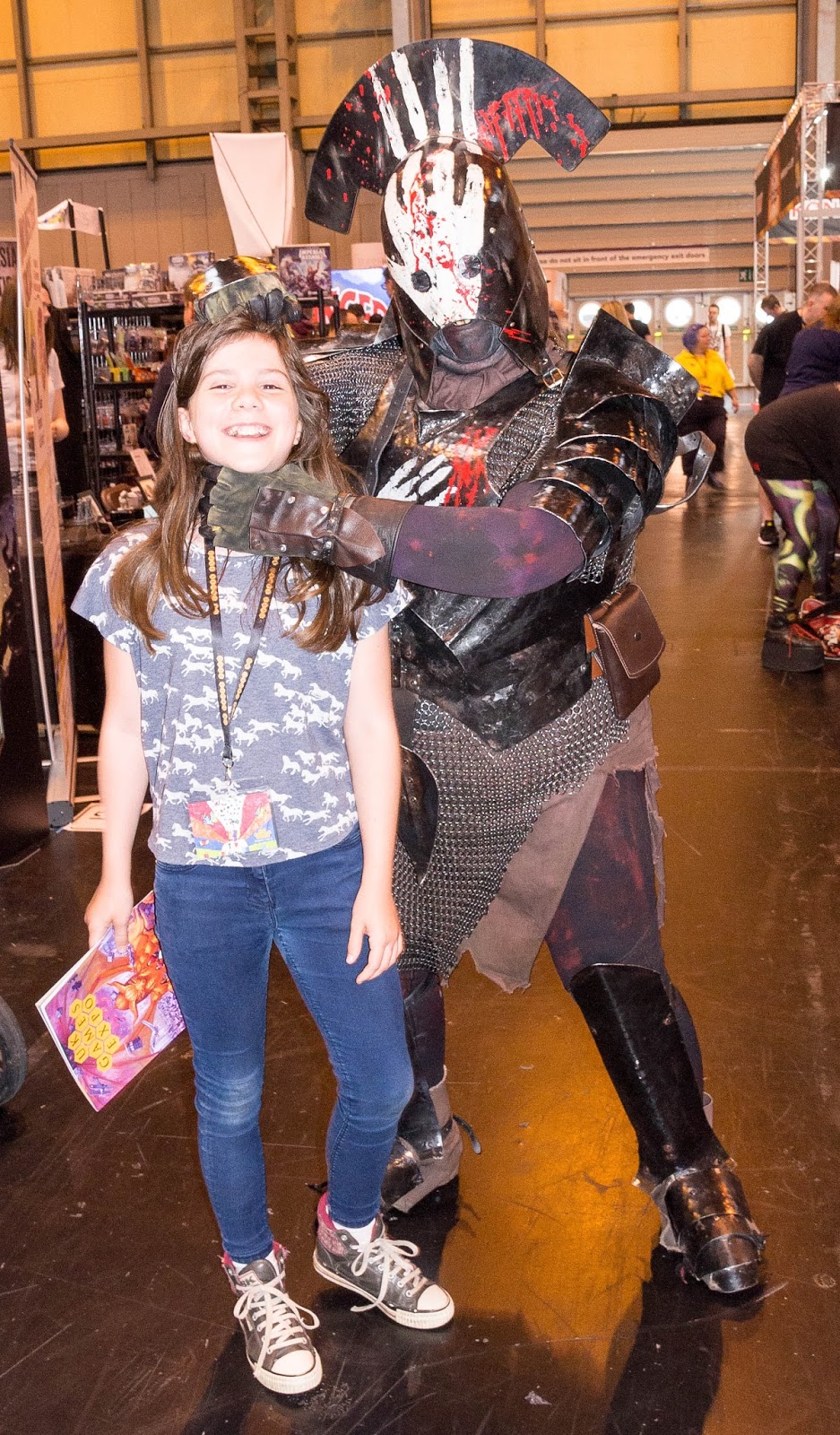
We spotted this Uruk-hai...


...but unfortunately it spotted Esther too...


After escaping that, more peril came in the form of a Dalek


but we slipped by and looked at a selection of props


including this cute BB-8


Back towards the entrance, we stopped by the Hawk Wargames stand - they had their full display, including 10mm scale frigate, demo tables, displays, retail stand and some tables where they'd run a competition of "build your own space station". 


We were too late to enter this, but you could still build something, so we spent a while whilst Esther created quite a cool little space station. I think this was a really cool idea by Hawk, and there were dozens of entries, indicating that this had been very popular.


They also had an area with Dropfleet ships being painted, again they'd thought about how to reach out and engage a demographic which included a lot of non-miniatures gamers. Bravo!


We then decided to try "Ticket to Ride", and in the interests of time we chose the children's version, which has all the elements of the main game but with shorter routes. I did well to start with, but then floundered, and Esther won by getting an "East to West" achievement that got her to the needed 6 points. It was fun, and definitely now on the list for Christmas!


We then had a wander about shopping - I bought a large solid metal D20 for "super important rolls" in our 5th ed campaign, I found a Nuka-Cola bottle-opener keyring for Oscar, Esther got a soft Pikachu toy, I found a 5x5 "Professor's Cube" for Clara (she can do a standard Rubiks cube in a couple of minutes) and a True or False game for Lotte. We also got the pictures version of Codenames, since everyone in the family enjoys the standard version.  

I wanted to swing by the 40k booth again to get some close-ups of the minis in the Dark Imperium 2-player set that is coming out (and I've pre-ordered), so here they are. The paint-jobs on these are pretty basic "base plus wash", yet the minis still look very impressive. I'm quietly excited to get my set soon and have a proper look. We also got a load of badges for the children here, always nice to get freebies!


Of particular interest to me were the nurgle chaos models, especially the poxwalkers which I wasn't that sold on from the main GW site pictures. I have to say that with more subdued painting, they look fantastic - I think some of the "cartooniness" I had feared before was just from the studio paintjobs.

We had another circle around, poking at dice, looking at interesting things, but our time was almost up and it didn't seem like we'd been there for 4 hours with no break - Esther didn't complain once. The show was quite an eye-opener, and Oscar was sad that he hadn't come along too - next year I think we'll go for at least 2 days and really try a lot of what's on offer, because there's sooo much! You can go to the games library and rent games out to try, try every sort of game you can think of, from cards to board to miniatures, dress up, go to seminars - to say nothing of the tournaments that are held in a completely different hall for 3 days, and the events at the Hilton nearby too. I definitely had a sense of touching the tip of the iceberg with the UKGE, and if you're in two minds whether to go, definately do! It's family-friendly, easy to get to and Birmingham has plenty to do if the rest of the family tire of games (what's wrong with them??!).

I thus leave you with Pirat, because, why not? It also shows the breadth of what's on offer at the show, plus a pirate rat, what's not to love??

Sunday, 23 April 2017

Salute 2017


So another Salute show has come & gone - what did this one bring?

Well, for starters this was Oscar & my first Salute show in 4 years that we'd not been at the SG stand helping out, so it gave us a lot more time to look around, and that was a great thing - how much we'd missed out on in prior years! To start with, this year the bag had the Salute exclusive mini;


Also in the bag was another model, this time an injection moulded plastic figure for Wild West Exodus, which is another good thing! They actually had a stand at the show too, together with somone actually dressed as Captain Nimue - and no, I didn't take a picture!


Now having a look around Salute all day is (as many of you will know from any show) an exhausting experience. Gamers are a mixed bunch, and the amount of pretty rude and backpack-wearing blunderers in the show seems abnormally high! Still, that aside, most folks are pretty cool, and we got to meet face-to-face a fair few folks we'd had on the Hub Systems podcast, which was great.

Anyway, let's not get ahead of ourselves - what did we see at Salute? Well, let's run down our highlights;
  1. Runewars
  2. D&D Figures
  3. Hawk Wargames
  4. Dark Souls
  5. Shattered Void
  6. The Drowned Earth
  7. Mierce Miniatures
I'll also talk a little bit about the Spartan Games stand, and some other random thoughts that come to me...

1. Runewars

So let's kick off with Runewars. This is Fantasy Flight's entry into the fantasy wargaming genre, and I've been thinking about it for a while, especially so after watching Sorastro's YouTube guides to painting (https://www.youtube.com/user/Sorastro). After watching a small part of a demo game, I decided to take the punge and buy the absolutely enormous box, at a discounted show price (though I later found it for slightly less elsewhere in the show....well, you can't win 'em all, can you?). I'm going to do a proper unboxing on this one in another post, so will leave those thoughts for then.

2. D&D Figures

Salute is a dream if you're looking for figures for D&D - there are so many manufacturers and traders selling appropriate items, from generic adventurers through very specific classes (Halfling Barbarian, anyone?) to monsters of all sizes and shapes (giant rats and beetles to enormous dragons). I picked up a couple of Wizard/Mage figures as they looked ideal for Red Wizards of Thay for the Rise of Tiamat campaign. Here they are:


3. Hawk Wargames

Hawk are easily identifiable at major events like salute because of the 10mm scale frigate that Dave and his team constructed and cart about as a central icon for their stand. This was as impressive as ever, and around it were demo tables with both Dropzone and Dropfleet. Behind it is the trade booth with product and display cases. I wanted to get an Athens for Oscar's UCM, and also another for a friend over in the US. Unfortunately we got to their booth after the first 30mins of the show in which all 150 they brought sold out. They did have Corvettes, launch assets, resin objectives and other pieces, which I was sorely tempted to buy, but also found them at a lower price through other traders (unsurprisingly!).

On display were the new casts for the Scourge and UCM Battlecruisers, which looked great - the Scourge one looking especially good. 


There were also the advanced sector tokens for display as well:


There were full display cases with fleets for all four races, looking as sexy as ever, this time with the Corvettes added to them. There were plenty of staff around, including Hawk Dave himself, and the stand felt like it was buzzing every time we went to it or past. In short, Hawk seemed to be having a really good day, and their games seem to be doing very well.


4. Dark Souls

We backed the Dark Souls Kickstarter, and this was the first time we got to see physical models and play first hand. The models are beautiful, and the gameplay is as brutal as in the video game. Oscar and I played the warrior and the herald against the Dancer, and actually did ok - getting it down to 6HP (from 34!) before I finally succumbed to a nasty attack (and when one of you dies, you all die!). The AI system is very good, and the models are incredibly detailed for board game items - something we all tend to expect nowadays. The chap who demoed the game was very good, and showed us all the models first hand. We had such a good time we forgot to take any pictures, so here's one borrowed from Beasts of War to show the Dancer in action


Really looking forward to getting this when it hits UK distribution!

5. Shattered Void

Meeting podcast guests in person is always a pleasure, and that was very true of the chaps at White Dragon which we covered in Episode 23. Oscar and I both backed their Kickstarter, and the ships shown at Salute this year still look great and the plastic games components and cards also look really nice - the stats slider is particularly good, and has a really nice feel to it when using the sliders - something like this for Firestorm would work really well, I think. Alan & Mark were pretty hoarse from talking most of the day by the time we met them, which is a good sign for the game, and we look forward to getting all of our goodies when they arrive soon!

6. The Drowned Earth


We covered The Drowned Earth in Episode 29, and met James to put a face to the name. We also got to play a demo game, where Oscar tried to crush my lizard dude with his hulking simian, jumping down a platform at him after taking three arrows from my leader...only to have his cold-blooded nerves of steel win for him, as he shot him squarely between the eyes as he sailed through the air at him, stepping aside as the lifeless body tumbled down the stairs behind him. He then bravely raced toward the objective to transmit the coordinates, only to be reduced to a flaming corpse by a dual hand-flamer wielding woman guarding the stairs. Oscars strange cross-dressing chap then successfully reached the transmitter, as my monkey-man couldn't shoot for crap.

Their Kickstarter is live, and I'd throughly recommend both listening to The Hub Systems episode where we talk to James and backing the game (we have!), as it's a very cinematic and fun game, with some really nice unique elements, such as the mixed factions (not "Apes vs Humans" or "Lizards vs Women" etc). I'm not sure how long we played (maybe 20 minutes?), but it felt like five minutes of complete fun - our thanks to Chris for that, he did a great job. The minis are very good, and seeing them cast when we were talking about initial concepts, art and renders back in December was a real treat. Also, although James was pointing out the unfinished bits of his boards for the game (you always see the flaws in your own work!), they actually looked great and really added to the experience.

7. Mierce Miniatures & Darklands


The Mierce Miniatures stand has drawn our attention over the past few Salute shows due to its incredibly detailed resin monsters, and this was no exception. This time they were also giving out free rules for their game Darklands. Their miniatures are absolutely A1+ grade, but they are pricey (though compared to GW, this makes more sense, and compared to Forgeworld there's no contest). Giving the rules and lore booklets out for free is a nice move, and I'll have cast a critical eye over them in the near future. For the time being, however, they remain as eye candy. If the prices were 20% or so less, they would be very desirable purchases, at the moment I think they're just too high-end to appeal to many beyond the exceptional display-piece painters out there.

Unfortunately Mierce's website is horrible, and really doesn't make it easy to showcase their beautiful sculpts, so the best place to see them is at shows. They organise models by factions, which unless you're already a Darklands player (unlikely) you've no idea where to look. This might make sense for the creators, but it doesn't help at all for new players to get into the game.


As an example, you have to go through about 4 screens before you get to see the mini above, which is a really nice sculpt and very nicely painted - yet hiding in the recesses of the site. Really the first thing you should see when you get onto their site are models like their Chimera, which is simply staggeringly beautiful. Unfortunately, even knowing what to look for, all they have on their website is this:


Now you can tell this is nice, but they have a painted mini, which shows the detail off beautifully and there's also absolutely nothing to show scale here - the actual model is massive, so why not have another stunning 28mm model paladin or something fighting it to show this? I mean, at the RRP of about £120, you need to see what you're getting! I think this is really limiting Mierce at the moment - they haven't really understood that their website is their shop window, and at the moment it looks like the outside of a German adult store.

Final Thoughts

Salute 2017 was a good show - it was great to see gameplay in person of games we've backed through Kickstarter, and good to meet the people we've chatted to over the ether for the Podcast, and see their labours come to fruition. It got me excited about mini games and painting, which is always a good sign. My main regret was not buying more Hawk stuff, but then I need to get more built and painted first, so that's probably a good thing!

Now of course I haven't mentioned Spartan Games here - something many of you may be glad about! Well, they were present, but with quite an underwhelming stand, with Halo being (perhaps predictably) the most predominant game. One could argue that there are good reasons for this, they're doing a lot behind the scenes etc, but let's face it - at a show, who cares about that? No one, that's who. Spartan need to improve their game dramatically or they're going to find it impossible to claw back any market share for their games beyond their status as a niche with a dedicated following. 

Having seen the leaps and bounds Hawk have made, and the abundance of fun, slick-looking games made out of people's attics (as Shattered Void is), then if they want to survive they need to do better, MUCH better. They've made a whole bunch of promises lately, but then Spartan's promises aren't even as good as GWs loose rumours, so we'll wait and see - it's not like  haven't got a whole lot of other shineys to look forward to right now!

Salute is a very particular kind of show, a real showcase exhibition point in the UK gaming calendar. It's a great show for looking at what's hot and upcoming, and you can bag a few bargains along the way (Terminator game for £10 anyone?...no, we didn't think so either....!). It's still a firm date for any gamer, though you need to get in early to grab those desirable show exclusives. If you're not concerned about that, its big enough and lasts for enough of the day that you can take it at a nice pace, though its still exhausting, and I still hate paying double for anything food or drink related "just because it's London". That's not enough to dissuade me from going, however, so I'll be looking forward to next year!

Wednesday, 4 January 2017

2017 - What will it bring for us gamers? Part 2: Hawk Wargames

Whatever your opinion of 2016 in other ways, it was a pretty good year in gaming. The hobby as a whole is growing at around 30% where most industries can hope for about 10% of that. We saw the arrival of some major new franchises like Dropfleet Commander and GW seem to be organising themselves in a slightly better way in many areas, despite still carrying on with Age of Sigmar (!). The rise of the board game strengthened more than ever, and there were a lot of great Kickstarter projects that were announced/launched and sometimes fulfilled. Not a bad time at all to be a gamer.

After looking over the Man Battlestations Blog, I thought it might be fun to do a similar predictive series of posts here over the coming days. So, what do I think is on the horizon for 2017?

Hawk Wargames

Hawk had a tremendously successful Kickstarter with Dropfleet Commander. It had a lower target than SGs recent DW campaign (£40k vs £50k), yet found almost 4,000 backers to fund it by a massive 1570%. Hawk struggled to fulfil in time, and is still sending pledges out now. It has also come under criticism for supplying retail outlets before fulfilling Kickstarter backers, though personally I completely understand why it did this - because it will have commercial agreements which are largely independent of any KS-funded project, and these relationships are more important collectively than any individual backer - no matter how unpalatable that might seem, it's a cold hard business fact. The alternative would have been to delay commercial release and piss off its distribution channels....

Anyway, Dropfleet happened and DZC continues, born along by Hawk's team and understanding of how to grow and support its community. That reputation will have taken a blow through the Kickstarter experience of many, but I don't think this will affect Hawk in the long run. Why? Especially as I've been so harsh on Spartan for similar delays in supply over the past year. 

Well, admittedly I don't have the "behind the scenes" view on Hawk that I did on SG, but just look at how Dave created Hawk and DZC in the first instance. The game was planned meticulously, beautifully produced and developed with the community and tournaments in mind. They stick to production schedules and give customers advance release notices - in short they set expectations within their grasp and fulfil them. They have released 2 games in their existence, both of which were produced in the same sort of polished manner. I get the delays piss people off, but let's be realistic, how many Kickstarters that have funded over 1000% delivered on time? Anyone ever been involved in a project which had 15 times the demand originally expected? Given that' they've performed ok I think.

Hawk are involved with and communicate to their supporters about 1500% more than SG do too, at least. They're still a small company too, but I think Dave fundamentally grasps what makes gamers tick and tries to scratch that itch - it's more about nice models and mechanics that were innovative in 2009. Look at their background development - there's more fluff in DFC from the start than exists in FA in 7 years of development!

So what do I think Hawk will do in 2017? They'll sort out their fulfilment issues and fill out their factions for DFC - battlecruisers and corvettes, shiny space stations and more. they'll work on shows and developing their community, and also making conjoined campaigns - I think that DZC will also benefit from the adoption of DFC. I'm seriously considering going back and looking at it since buying DFC, despite my lacklustre feeling about the 2-player set for DZC that Hawk brought out a few years back. I also think that they'll toy with developing a deep-space combat version of DFC, though I don't think that will happen this year - they might wait until BFG and FA show their hands first, and decide if they should or shouldn't thereafter. You get the feeling that decisions like this are thought about long and hard at Hawk, and then planned properly before implementation.

So I think Hawk will do well because they are growing from an established core base in a methodical and pre-planned way. Yes, DFC was more popular than they expected, but what a problem to have! Given that there have been a ton of people jump on board AFTER the KS, like Oscar and me, by going directly to retail I think they have a very rosy future ahead, and I think they'll do that with a steady and throughly planned release schedule in 2017. I must say I'm looking forward to it...

Thursday, 15 December 2016

Dropfleet Commander & Firestorm Armada side-by-side - Part 2: Game Mechanics

In the second of my side-by-side looks at DFC vs FA, I'm going to look at how the actual games stack up against each other. This post is really a comparison of the mechanics nuts and bolts, and not how the games actually play, which I'll do for the next in this series. So let's plunge straight in....

Basic Stats

Firestorm Armada

Designation - What type of ship this is - e.g. Battleship or Frigate
Size Class - Small, medium or Large - also designates whether the ship is a Capital ship or not
Squadron Size - the number of ships present to make up a legal squadron (e.g. 2-4)
DR - damage Rating - the value that must be reached to damage the ship
CR - Critical rating - the value that must be reached to critically damage a ship
Mv - Movement - How far in inches the ship can move each activation
HP - Hull Points - the amount of damage the ship can take before it is destroyed
CP - Crew Points - the value of the non-combatant crew running the ship
AP - Assault Points - the value of the marine contingent aboard the ship for boarding
PD - Point Defence - the value of systems used to defend against torpedoes, SRS and boarding
MN - Mine value - the strength of mines laid by the ship
Points Cost - self explanatory
Shield rating - the value of any shield systems the ship has (including Cloaking fields)
Wings - the value of SRS (Short-range spacecraft) the ship can accommodate
Turn Limit - how far the ship must move before it turns 45degrees

Dropfleet Commander

Scan - the range of the ships active search systems in inches
Sig - Signature - how "visible" a ship is, in inches added to an enemy's scan range
Thrust - How far in inches the ship can move each activation
Hull - the amount of damage the ship can take before it is destroyed
A - Armour - effectively a "saving throw" per damage point, expressed as a dice value (eg 4+)
PD - Point Defence - the value of systems used to defend against Close Action and Launch Assets
G - Group - The normal operating range for the ship, similar to Squadron Size in FA
T - Tonnage - What size class the vessel is for fleet building
Special - Lists any special rules such as Launch and Atmospheric
Points - self explanatory

Force Size and Building

Firestorm Armada

Firestorm Armada has three main levels of play - Patrol Fleet (up to 800 points), Battle Fleet (801-1500) and Grand Fleet (>1501). It has to be said that the vast majority of games are played at the first two levels, since people find the Grand fleet level takes too long.

Within the various game sizes you have three Tiers of ships - Tier 3s, which are generally small Frigates and Corvettes, Tier 2s, which are Cruisers, Gunships and the like and Tier 1s, which are everything from a carrier up to dreadnoughts. Depending on what points level you play will determine the minimum and maximum number of the different squadrons you have in your various Tiers. There are various other restrictions and possibilities layered on this, plus it is possible to customise individual squadrons of ships, so you can build an extremely diverse set of fleets for any race at any points level.

Cost of ships range from 15points for an escort or corvette, around 20-30 points for frigates, 40-90 points for medium ships such as cruisers and the like, around 170-220 points for Battleships and around 280-350 for dreadnoughts (the largest ships currently in the game)

Dropfleet Commander

Dropfleet also has three levels of play - Skirmish (up to 1000 points), Clash (1000-1999) and Battle (2000-3000). As the game is new I can't really comment as to practicality at the higher levels compared to FA.

Fleet organisation is a bit different to FA, as you assemble your forces from "Battlegroups", each Battlegroup being made up of various ships (not restricted to the same type). There are four types of Battlegroup (Pathfinder, Line, Vanguard and Flag), and four categories of ship that can go into a battlegroup (Light, Medium, Heavy and Super-Heavy). Battleships are Super-Heavy, and only come into Clashes and Battles - this is an interesting setup, and as each Battlegroup has variable composition, you get a wide range of options...If I got it right at Skirmish level you can have 0-2 Heavy, 1-8 Mediums and 0-10 Light Ships present.

Cost of ships range from around 22-50 points for Light, 79-140 points for Medium , around 155-210 points for Heavy and around 220-285 points for Super-Heavy (the largest ships currently in the game)

Game Size, Scenarios & Setup

Firestorm Armada

Games tend to use a 4'x6' table regardless of game size due to the long weapon ranges and design heritage. There are 6 core scenarios in the core rulebook, which was expanded to 10 with the System Wars booklet (you don't necessarily need the supplement ships to play these, though its recommended). Setup of the game can be done in several ways, and recommendations for placement of terrain (asteroid fields, gas clouds, planetoids, debris fields, gravity wells and comets) together with their effects are all provided. Setup is a pretty painless procedure, though agreement on what an "average" table looks like varies depending on local meta.

Dropfleet Commander

The recommended table size is 4'x4' - an obvious and immediate difference to Firestorm. There are 8 scenarios in the core book, and it has to be said these are a lot more objective-driven than Firestorm's, partially because of the nature of the game (orbital deployment and defence rather than deep-space combat). The DFC rulebook also goes on to talk about Ways to Play, Tournaments and integrating DZC, as well as running Campaigns and days - this shows Hawk's approach to its games, which is very much about building the community and building its games towards this - something it definitely wins out on here in DFC and generally as a company.

Gameplay - General

Firestorm Armada

FA is an alternate activation game, and was quite early on the scene in this regard. Players can use a tactical card (TAC) before rolling initiative each turn, bring in reserve forces (if applicable), then activate a squadron of their choice from those left to activate. In the Squadron's activation it can move, shoot and perform other actions like laying mines, launching fighters and bombers, and attempt boarding actions. Once an individual squadron has finished all of its actions, play passes over to the other player, who then chooses one of his squadrons to activate and so on.

Dropfleet Commander

DFC is also an alternate activation game, but this is done by Battlegroup rather than by ship squadron or group. The order of these groups activation is defined at the beginning of the turn by use of Battlegroup cards, the order of which is set by the player in the Planning Phase of the turn. This is the first major departure in gameplay which gives a slightly different feel to the game. During a Battlegroups activation, each group within the battlegroup can activate in any order the player wishes. this means you have a strategic choice to make at fleet building - more Battlegroups with lower numbers of Groups, or more Groups in less Battlegroups. There is also the option to use a Special Order before a ship activates, which is something similar to the TACs used in Firestorm, but applied at a more individual tactical level, since each ship in a Battlegroup can choose whether or not to use the Special Order. These "Ships Orders" are an important part of the flavour of the game, since they determine how the ship behaves and also affect its Signature value, making it more vulnerable to attack.

Gameplay - Movement

Firestorm Armada

Ships in FA move like wet navy ships, having a minimum move and a turn limit. Movement can be ponderous - 6" with 45 degree turns every 3" - or rapid - 14" with the ability to turn a 360 in 8" - depending on the individual ship (smalls generally being faster and easier to turn). 

Dropfleet Commander

Movement depends on the Orders given to a ship, rather than by the type of size of a vessel;

  • Standard Orders - Turn at the start of activation, and move from half to all of its Thrust value. 
  • Station Keeping - Uses 0-half of its thrust movement with a turn at the start or end of its move
  • Course Change - two turns at any point during its movement
  • Max Thrust - Turn at the start and use up to double movement
Any of these orders other than "standard", however, inflict a "Minor Spike, which adds 6" to its Signature value. there are some other Orders which affect movement too;
  • Weapons Free, Silent Running & Active Scan - All prevent ANY turning that activation

Gameplay - Weapons and Firing

Firestorm Armada

Ships in Firestorm have variable numbers of weapons systems, which are broken down into "Direct" and "Indirect" types - both of which have general rules around them, such as Indirect weapons not requiring LOS and not degrading from combat damage. The Direct weapons come in different flavours - Kinetic, Beam, Nuclear, Scatter and Primary - each of these having different properties associated with them. Indirect weapons also come in different types such as torpedoes, cyberwarfare and gravity. Weapon Systems all have 4 range "bands" (1-4), but the size of each of these depends on the weapon class - a Primary weapon has 8" bands, a kinetic weapon has 12" bands.

Arcs in FA are Fore, S/P (as in the example above), Aft and Fixed Fore - the latter being a channel the width of the ship's base. There are also turrets which have a full 360 range and gunracks which are P/S weapons that can only fire into one of the side arcs at a time.

Each weapon has a profile like this;


This shows the weapon type (in this case a Beam, which has 10" range bands), an Arc (in this case Port/Starboard broadsides) and a number of dice to be rolled depending on where the target is located. So up to 10" we would be rolling 12 dice, between 10 and 20 we'd roll 16 etc.

We then roll these dice, with a 4+ being a hit (unless other rules come into play, like difficult target etc), and using the exploding 6 mechanic that is present in most SG systems (every 6 counts as 2 successes and allows another dice to be rolled). 

Small and Medium ships have lower AD values, but can link their attacks as a squadron. in this way smaller ships can "gang up" to damage larger ships.

Overall the feeling in Firestorm is rolling big handfuls of dice to overwhelm the defences of your opponent - you can be rolling up to the low 20s in terms of number of dice. Having said that, you are still at the mercy of dice, though the number rolled have a statistical evening effect.

Dropfleet Commander

Firing in DFC is a bit different from FA. Firstly, weapons don't have ranges, ships do - the range is the Scan range of the ship you're firing with, plus the Signature of the Target....now all those "Spike" values start to make sense...you can turn hard, but you're increasing the range that the enemy can shoot you at!

Now weapons in DFC also have a stat line, and heres an example;


  • Type - Descriptive text of the weapon
  • Lock - what the weapon scores hits on
  • Attack - the number of dice you roll
  • Damage - the hull points removed for each successful hit
  • Arc - as for Firestorm, you have similar arcs, though named S (L) and S (R) for Port/Starboard. also unlike firestorm, a weapon might be F,S(L) for example, meaning it can fire in either front or side arcs. this will be familiar to DZC or Planetfall players
Overall DFC feels a lot more like a developed GW mechanic, which is unsurprising given Andy Chambers involvement in the project (though this may also be very familiar to DZC players too!). Numbers of attack dice are much smaller - topping out at 6AD for some battleship systems (around a quarter of what FA tops out at!).

Damage and Attrition

Firestorm Armada

If the total equals or exceeds the DR, a HP is lost - if it exceeds the CR rating, it receives 2 HP and the attacker can roll on the Critical Hit table, which has effects from losing crew to detonating the ships reactor. Attacks which reach the CR threshold a number of times inflict 2HP for every multiple, with a corresponding table roll if the ship is still alive.

Shields may be rolled to remove hits, and these use exploding dice as well, though typically these are only 1 or 2 dice )3 or 4 being the high upsides). PD is used against Torpedo attacks in addition, and PD values can range from 1-9 depending on ship class and size.

Once damaged, ships begin to degrade in effectiveness - every HP of damage reduces the AD of the ships DIRECT attacks by 1, and also the PD. This makes Indirect weapons like Torpedoes - which don't degrade in this manner - much more effective, so the balance of weapon's effectiveness changes across the course of the game.

Dropfleet Commander

Critical hits are handled differently in DFC too - if your dice hit with 2 or more than you needed (so a 5+ in the example with a 3+ Lock above), they score a critical hit, which means you don't get to use your Armour value to attempt to prevent the damage.

After rolling attack dice and determining hits and final hull points of damage, the receiving player can roll dice for their Armour for any non-critical hits to attempt to reduce damage. Critical hits may not be defeated by Armour, but may be reduced with Passive Countermeasures if the ship has them active. Some weapons have the Close Action Special rule, which means you get to use PD against them, which can take out critical hits at a 2:1 rate.

If a ship takes more than half its hull in damage, it must roll for "Crippling Damage". this is a one-off check, unlike the Critical table in FA which is rolled on every time a critical hit is scored. Essentially this helps to kill damaged ships, shortening the life of vessels and helping to prevent "Zombie Ship" syndrome, which can occur in FA. Also when a ship loses all its Hull, you roll for Catastrophic damage, which determines the ships fate and effects - which again helps kill stuff around it.

SRS & Launch Assets

These are the fighters, bombers, interceptors and other small craft that both games have.

Firestorm Armada

Firestorm refers to these craft as SRS (Short Range Spacecraft), and they come in several flavours - Fighters, Interceptors, Bombers, Assault Shuttles and Support Shuttles. They are handled in the movement phase of their parent carrier, and may be launched and perform an attack run on a target within range in the same turn, or they may stay within range of their carrier to perform an attack run in future. SRS may also combine their PD values to prevent torpedo attacks in the vicinity. 

Dropfleet Commander

Launch Assets (as DFC calls them) can be launched against a target within twice the thrust range of the type of LA, except Dropships and Bulk Landers, which can only launch against targets within Thrust range. These are all launched in the Roundup Phase, which occurs after the activation phase of a turn. Dropfleet also classes Torpedoes as Launch Assets, whereas FA has Torpedoes much more like missiles in DFC. Once again, PD systems may be used to help ward off the attacks on a ship from Launch Assets - except for torpedoes. A ship may attempt to outmanoeuvre Launch Assets as well (including torpedoes) by using Course Change or Max Thrust orders. 

Special Rules

Firestorm Armada

Firestorm handles special rules with MARs - Model Assigned Rules, of which there are over 60 of at the moment. These provide all kinds of effects, and individual ships can have anything from zero to half a dozen, often with the option of gaining more.

Dropfleet Commander

DFC has around half of the special rules FA does, and these are separated into Ship special rules and weapon system special rules, with a ratio of about 1:2. They have some important key concepts however, like the Burnthrough rule on some weapon systems, which uses a type of capped exploding system.

Unique Elements

Firestorm and Dropfleet are both games designed for slightly different purposes, so a very direct comparison is somewhat difficult. This section talks about some of the things that are largely unique about each system.

Firestorm Armada

Boarding

Ships in Firestorm may attempt to capture each other during play, and although quite a variable tactic in terms of success, used well it can be decisive. As far as I can see DFC has no similar mechanism within the game. Rules for boarding are pretty simple and it's possible to build a boarding-heavy fleet, though in general it's a risky strategy.

Mines

Mines are a minor mechanic in Firestorm, but one that can have pivotal effects in games. Again, from what I've see so far there are no similar mechanics within DFC. This is understandable, since mining your own planet's atmosphere is probably unwise!

Dropfleet Commander

Orbital Combat

The main thing that is obviously different about DFC is that it occurs around a planet, including it's outer atmosphere. This is represented in game and has various affects on gameplay. The rationale behind Dropfleet is often to deposit assets to capture ground targets, which requires ships to enter the atmosphere. You have mechanics to traverse the orbital layers, and also one for "Orbital decay" (yes, it sounds bad, and it is bad - well, if you like keeping your ships intact and not as a firework display for your ground troops, anyway!)

Ground Combat

Although a space game, as you are landing assets on a planet, the ground combat element of this is also rendered in game as part of each turns Roundup Phase. You also have the extreme option of "nuking a site from orbit" - I can't wait!!!

Roundup & Conclusions

Well, it's difficult to make any conclusions from a simple comparison of mechanics, especially as I've not yet properly played DFC yet. However, just on initial impressions there are clear differences in the approach and rendering of game elements. Ironically perhaps, I can see tweaking both games to fit with each other, representing deep space and orbital combat respectively, which would be pretty cool.

Interestingly, there are some elements of both games that seem somewhat old-fashioned when compared to each other. The main differences do go back, however, to what each game is trying to achieve, and the approach of the two companies - Firestorm is much more about a straight-up fight with no real eye to tournament play, whereas DFC is all about objectives and the planet, with a definite nod to narrative campaigns and tournaments.

In some ways I'm not sure a direct comparison is possible or desirable here, I can see playing both games without too much difficulty or overlap, to be honest - I think they're scratching different itches. I can see someone who enjoys DFC enjoying FA and vice-versa, and certainly the models are compatible in terms of size, scale and number.

So I'm afraid, perhaps somewhat unsatisfactorily, I'm going to defer any proper judgement on the games until I've played them side-by-side with Oscar, and get our distilled wisdom down on the virtual page. Until then, enjoy the space ships!

Sunday, 11 December 2016

Dropfleet Commander & Firestorm Armada side-by-side - Part 1

So this was obviously inevitable, but I thought I'd put the two games side-by-side and draw up a set of compare and contrast items to let people know what they're getting into with both games.

1) The Companies

I think given my recent history this is an obvious starting point, but it may not be obvious when people are considering a game system. To me it has always been since my GW experiences, and my initial experiences with SG were extremely favourable, which was in sharp contrast to the treatment GW was handing out to its customers. With more and more companies and games on the market than ever before, I think this is more important than ever.

1a) Spartan Games

Spartan is a small UK manufacturer, started and run by Neil & Frances Fawcett. It started with Uncharted Seas, and firestorm was its more successful second game, and really catapulted it into a more global marketplace. Back in 2009 when SG started Firestorm, the market was ripe for new companies with new attitudes. Customer support was great, and they had an active community for their games. In 2015 they gained the Halo license from 343 studios, and games like Planetfall, Dysopian Wars and Firestrom Armada have seemed to take a secondary rank behind the Halo franchised games since that time. They don't have a great reputation for following through on promises, often giving grandiose plans that aren't followed through on.

1b) Hawk Wargames

Hawk is another small UK manufacturer, started and owned by David Lewis. It started in 2012 with Dropzone Commander, a 10mm scale game that captured a lot of people's imagination. Dave worked on DZC for over 2 years before bringing it to market, and he did a lot of the work  - design, sculpting and painting - on the original DZC himself. Hawk have a reputation for community building, show attendance and tournament support. The release of their second game, Dropfleet Commander through Kickstarter has attracted some criticism from backers due to fulfilment delays - many waiting long after retail sales to receive their pledges.

2) Backgrounds & Universes

For many people, the "story" of their battles is a lynchpin on which their enjoyment hangs, for others it is nice window dressing and some don't care either way (though I think they are in the minority, or else why play any individual game?).

2a) Firestorm Armada

Firestorm Armada has been criticised over the years for its lack of background material, despite the game having a huge number of races and ships - leading some to draw parallels with GW as Spartan being a model company rather than a games company. Two fleet guides for the major sides in their universes conflict were released in 2014, around 6 months after v2 of the game was available, and they filled in a lot of the blanks players had before, but mainly for the "core six" - the main protagonists in the game. In addition, Spartan's release of their 10mm ground-combat game Planetfall did not tie in well to their existing universe, with several differences in feel and direction in background on introduction and thereafter, especially over certain factions (like the lizard Sorylians and the arachnid Relthoza).

2b) Dropfleet Commander

Dropfleet has an advantage here in that it is a game created in an existing setting that was already very well thought out and had a lot of background pre-developed. Hawk have been good at providing detailed background materials, with a lot of supporting artwork, for their releases, which makes it feel like a more coherent and fleshed-out universe. The flip side to this is that Hawk have developed far fewer factions than Spartan, having four main factions in both games, with an additional one in their ground combat game.

3) Factions & Setting

The universes that games companies create need to be sufficiently expanded to appeal to a broad range of players - what one person thinks is cool another will not. Having sufficient expansion potential for a game from a player's point of view is often a big part of getting into the game - what commitment is required from the player, is there a broad church of options, and how much is it all going to cost to get playing properly.

3a) Firestorm Armada

At present there are 22 factions for Firestorm, falling into three broad categories - The Kurak Alliance, The Zenian League and the Marauders & Mercenaries. The latter comprise elements that can combine with either main division plus a "monster" type faction that stands alone. Six of these are the "core races", including the broadest choices of ships and most developed background, though that is fairly scant even fro these races. The factions for Firestorm are;

The Kurak Alliance

  • Terran Alliance - Core race (Humans, corrupt and overbearing - a bit like the 19th century British Empire)
  • Aquan Sebrutan - Core race (Aquatic multi-species conglomerate with semi-organic ships)
  • Sorylian Collective - Core race (Lizard engineers with a strong sense of tradition and ceremony)
  • Hawker (Humans, Corporate entity which produces ships for the Terran Alliance)
  • Ryushi (The 9-foot tall remnants of a large empire looking for revenge against the Kedorians)
  • Terquai Empire (Human sub-faction that live in Aquan space with hybrid tech)
  • Tarakian (Ancient and mysterious race watching for the coming of the "old enemy")
  • Veydreth (Dragon-like mercenary lizards with a taste for human flesh)
  • Xelocians (Religious bird-like creatures on a holy quest in their world-ship)

The Zenian League

  • Dindrenzi Federation - Core race (Human separatists - hardy frontiersmen, like revolutionary America)
  • The Directorate - Core race (Human corporation, completely self-serving, betrayed the Terrans, stoking the war)
  • Relthoza Empire - Core race (Huge Arachnids with a strong martial honour system and cloaking fields)
  • Ba'kash (Savage raiders of the Sorylians, plaguing their wormhole network)
  • Kedorians (Mysterious slavers & traders with advanced technology)
  • RSN (The elite Navy of the traditional Dindrenzi Leaders home worlds)
  • Works Raptor (The Human weapons development experts of the Directorate)

Marauders and Mercenaries

  • The STL Syndicate (A criminal gang with its claws in the government of the Terran Alliance)
  • The STL Traders (the "legitimate" face of the Syndicate, with a gunned-up merchant feel)
  • OSO Omnidyne (An up-and-coming corporation in the Directorate, willing to do anything for money)
  • OSO Corsairs (Pirates! How Omnidyne gets things done whilst keeping plausible deniability)
  • Oroshan (Four-armed monkey mercenaries)
  • Pathogen (The Flood in FSA)

3b) Dropfleet Commander

DFC only has four factions, but each is fully fleshed out and meshes well with its DZC counterpart. They have consistent looks between ground and space, and each has a distinct identity.
  • United Colonies of Mankind (The traditional humans - think Colonial marines from Aliens)
  • Post-Human Republic (Progressive human splinter elevated by technology from a mysterious sphere)
  • The Shaltari (an advanced race that may have put humanity in harms way to save themselves)
  • The Scourge (a parasitic species that absorb other races and use them to expand themselves)

4) Miniatures

4a) Firestorm Armada

Materials & Construction

Spartan Games has a good pedigree in making resin miniatures, which the majority of its Firestorm Armada range are cast in. Some of the smaller ships are cast in white metal, as well as some of the smaller components to their ships (Hawker's Shield Generators and Works Raptor's shield panels being obvious examples). Spartan's metal casting doesn't have the finesse of its resin, and can be difficult to work with. Historically it's ships are mainly single pieces, though very early and recent casting have been increasingly multi-component. Unfortunately instructions are not provided for these, meaning you have to work out what goes where. Ships are usually very well cast, though some seaming and minimal flashing can be found, together with some casting gates. On the whole though, these tend to be small and easily cleaned up, and the pieces are well designed with production in mind. Thinner pieces can suffer from some warping, but again this is usually easily remedied, and if not then SGs customer service will replace items FOC without issue, though timing and communication on this depend on the volume of other business that's going on.

Scale, Size and Mass

Scale 1:10,000

Size & Mass: This varies quite a lot between the races, but I'll try to take broadly representative examples. I can only directly report mass comparisons between the battleships since they're the only models cast in the same type of materials.

Battleships:   A Terran Apollo battleship is 147mm long, 63mm wide, 45mm high and has a mass of 82g  
Cruisers: A Directorate Cruiser is 84mm long, 35mm wide and 13mm high
Frigates: An Aquan frigate is 50mm long, 25mm wide and 11mm high

4a) Dropfleet Commander

Materials & Construction

Hawk's main range of ships from its Kickstarter are all injection moulded plastic. Casting is crips and highly detailed, sprues are hugely thick but contact points are thankfully much smaller. The plastic is hard but not brittle, and easy to work with. Battleships for all factions are resin, and their casting quality & detail is at least equal, if not superior to, Spartan's. All components are resin, even very small parts, with no white metal present anywhere.

Scale, Size and Mass

Scale 1:9,150 (0.2mm scale)

Size & Mass: Once again this varies between the races, and I've used the PHR battleship as the comparator here.

Battleships: The PHR battleship is 175mm long, 70mm wide, 45mm high and has a mass of 35g
Cruisers: A scourge cruiser is 117 long, 36mm wide and 38mm high
Frigates: A UCM frigate is 62mm long, 18mm wide and 14mm high

Side by Side

Measurements are one thing, but side by side pictures is what i know everyone will want to see. Here are the Frigates;

And the cruisers

And lastly the battleships;

I think this shows the main aesthetic differences between the two games - Spartan's models are "chunkier" (for want of a better word), probably because they've come from a tradition of casting one-piece models, or multi-component kits were some of the multi-part elements are drop-cast, so have a flat, non-facing side for attachment to the model. Hawks minis have a much more delicate feel - although the injection moulded plastic makes them actually very durable. I'd worry a but about transporting my battleships with Hawk, because they retain the delicate nature but using resin.

I think a more useful or at least direct comparison of the two companies is probably served by SGs recent Reinforcement boxes, where SG have upped their casting detail and gone more modular. The pricing is also more reflective of that. Here are some comparisons between those boxes and the Dropfleet models

Aquan and UCM Cruiser


Close up of the detail on both models


Scoure and Directorate frigates 


Close up of the detail on both Frigates

For me, the models are nicely compatible, which is great because I plan to use the Scourge as a Pathogen fleet in FA, and maybe the UCM for Corsairs/STL Traders. The Shaltari will nicely substitute for the absent Illosians, which I have stats for and will also publish at some point.

4) Cost

Obviously these will all be in RRP

2 Player Boxed set: DFC: £65, 14 minis          FA: £90, 20 minis
Force Core boxes: DFC:£40, 7 minis      FA: £43.50, 7-10 minis (including Battleship); £30, 9 minis
Battleships: DFC: £30     FA: £18

Now this means that RRP you're going to pay £70 for a DFC fleet that's directly equivalent in terms of ships to an FA Patrol fleet at £43.50. However both sets hit the streets a lot less than than, and realistically you're looking at more like £58 for DFC and £35 for FA. So that makes the Hawk ships more expensive than Spartan's, but not by that much - from 25-40% more The DFC starter set also looks like extremely good value when you consider it contains a full rulebook and other extras, though the current SG set includes a smaller version (though still containing the full ruleset).

Of course cost is only really comparable in terms of what you need to play the game, and both games are pretty low-entry cost in terms of the wargames market. Hawk's sets also include a lot of extra build options, and a much greater diversity of kitbashing options by virtue of the leftover "spares" and the fact they're injection moulded plastic. Spartan's sets don't generally contain spares - you tend to use everything, only the new reinforcement sets that came this year having anything in the way of alternate builds.

So that's the background and physical minis for both systems. Next time will be gameplay...keep in touch :-)